Chemicals in Food: What's Really in Your Snacks
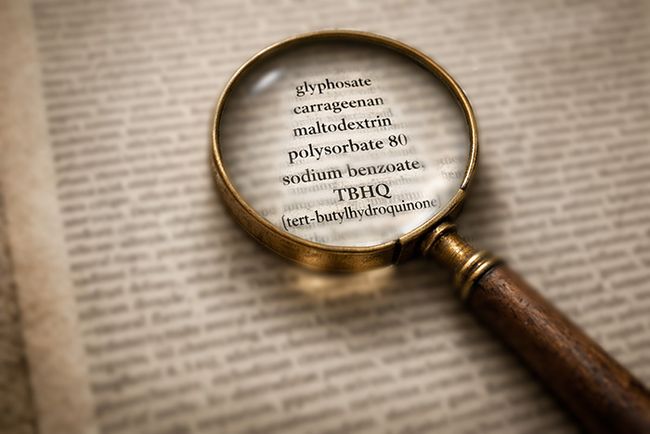
An AI Chat Reveals Difficult Truths About Chemicals in Food
If you landed here, I'm guessing you've been asking the same kinds of questions I have — about what's actually in our food, whether regulators are as concerned about food safety as I am, and whether "generally recognized as safe" means anything useful.
A Question That Stopped a Friend Mid-Scroll
A friend recently shared that she asked an AI assistant a simple question: What chemicals are allowed in foods sold at big box stores and major grocery chains?
The answer stopped her mid-scroll. She shared it. Then we couldn't stop thinking about it.
What the Research Shows:
- More than 10,000 chemicals are permitted in the U.S. food supply.
- Over 2,500 food additives and chemicals are intentionally added to modify flavor, color, texture, and stability — or simply to reduce cost.
- An estimated 12,000 more can enter food unintentionally through packaging materials, processing aids, pesticide residues, and animal drugs.
- Ultra-processed foods now make up 73% of the U.S. food supply.
- Between 2001 and 2019, the proportion of grocery purchases containing additives rose from 49.6% to 59.5%.
Let that sink in.
More content like this, delivered to your inbox.
SubscribeThe GRAS Loophole
Nearly 99% of food chemicals introduced since 2000 were approved not by the FDA, but by the very food and chemical companies that profit from them — through a legal loophole that lets manufacturers self-certify ingredients as "generally recognized as safe."
This is not necessarily a terrible thing in isolation — imagine if every food ingredient had to wait years for full FDA review. But in the context of FDA regulation, it does mean a burden of ingredient awareness falls largely on us as consumers.
We're not citing this to alarm you — it's the backdrop against which Delessa was created, and it explains why so many people are actively seeking healthier alternatives to snacks and everyday treats.
Why Chocolate Without Additives Is Harder to Find Than It Should Be
Many people searching for snacks without additives assume chocolate is off the table entirely. Finding chocolate without additives — free of processed emulsifiers, texturizers, artificial flavorings, or glucose-spiking sweeteners — turns out to be surprisingly difficult. Delessa was founded to solve exactly that problem.
How We Express Our Commitment to Ingredient Transparency
When we say four ingredients, we mean it as a complete sentence.
No "natural" or synthetic flavors. No processed or ultra-processed ingredients, chemicals, or additives to modify flavor, color, texture, stability, or to reduce cost. No color additives. No preservatives. Nothing that requires a regulatory loophole.
We put Delessa on the market because we simply got tired of seeing ingredients we didn't want in our bodies — and tired of seeing products that claim wellness while hiding their chemistry.
Our deep dark chocolate contains just 4 ingredients. That's not a marketing claim. It's the whole list.
- Raw organic nut butter base — quality plant fats, nothing refined, highly heated, or processed out
- Organic, fair trade, non-alkalized cacao — rich in antioxidants and magnesium
- Extra virgin organic coconut oil — medium-chain fatty acids that fuel body and brain
- Pure monk fruit extract — natural sweetness without blood sugar impact, no sugar alcohols, no digestive side effects
Why This Is Personal
I created Delessa because my own body is an unforgiving barometer for food quality. Since college, I've navigated a high level of sensitivity — even just a moment of 'junk' food required a green vegetable 'antidote' within an hour just to feel okay. I wanted real, simple, unprocessed food that didn't come with a physical tax. Delessa isn't just a product; it's the result of my drive to eat in a way that actually makes me feel good.
I realized that my sensitivity wasn't a burden — it was a compass. It led me to create a standard where 'minimal ingredients' isn't a marketing phrase, but a personal necessity. I know our customers are searching for healthier alternatives to snacks because, like me, they've reached a point where they refuse to settle for the 'physical tax' of ultra-processed ingredients. Delessa isn't just making chocolate; we are providing the peace of mind that comes from a label you don't have to second-guess.
Our customers care about being healthy. Dark chocolate can be highly beneficial — as long as it isn't combined with chemicals and less desirable ingredients like sugar, glucose-spiking sugar alternatives, sugar alcohols, gluten, processed corn, or dextrin, just to name a few.
You can have your chocolate without compromising your values. And statistics like these make clear why so many people are ready for something different — something made the way food used to be made: in a kitchen, with ingredients you recognize.
More content like this, delivered to your inbox.
SubscribeReal food. No shortcuts.
The food supply has changed dramatically in the past few decades, but our biology hasn't. Our bodies still recognize real ingredients and respond to them differently than to engineered ones. Whole food ingredients satisfy in ways that laboratory-created alternatives simply can't — and when your body gets what it actually needs, it stops asking for more.
Ingredient transparency isn't a trend. It's a return to something that was never supposed to go away.
Kindred Brands Worth Knowing
Once you start reading labels, you can't stop — and you start noticing which brands are genuinely committed to minimal ingredients and which ones are just marketing that way. These are brands I've vetted the same way I vet my own:
Hibiki-an — I source my organic matcha directly from this family farm in Uji, Japan. Its pure, shade-grown potency is the 'green' ritual I rely on for steady energy without the crash of processed stimulants.
PACHA Bread — I rely on their sprouted buckwheat loaves because they are one of the few truly minimal-ingredient staples that leave me feeling energized rather than depleted.
Le Pain des Fleurs — A permanent fixture in my pantry. Their commitment to simple, organic ingredients perfectly matches the 'clean slate' standard I need for my daily snacks — and they are wonderful with Delessa Chocolate Spreads.
River Organics — Since our skin absorbs what we put on it, I apply the same vigilance as I do to my food. Their zero-waste, plant-based approach is transparency in action.
By the way, matcha and dark chocolate are two of the highest-ranking foods for catechins and flavonols — a remarkable combination for promoting natural energy and long-term well-being.
Building an ecosystem of these minimal-ingredient staples is how I maintain my own baseline. It's that same uncompromising standard we bring to every jar of our chocolate blends — because when you choose clarity over chemicals, you're choosing to feel your best.
The FDA's Substances Added to Food database and EWG's Food Scores are two good places to start.
FDA — Substances Added to Food (formerly EAFUS) FDA — Select Chemicals in the Food Supply Under Review Open Food Facts
Explore the Delicious Simplicity of Our Blends
Four ingredients. Zero compromises. Real chocolate that stands on its own. | 25% off, automatically applied at checkout.
Delessa Chocolate Spread Blends →Almost 20 years of recipe work went into the four ingredients in every jar.
Our Story →